Planning Minutes – 08/06/09
Attending:
Committee: Chair John Bradley, Bill Welch, Roger Vrilakas, Don Genasci, Steve Pinger, Stephen Metzler, and Noel Johnson.
Guests: Mark Desbrow, Adam Tyler (neighbor), Mary Czarneke, Lee Stapleton, MIke Goldstein & Fran Goldstein, Jeannie (last name not known), neighbor, Kim Knox, Sheils Obletz Johnson, Meredith Hendricks, Mark Mikolavich, Greenleaf Architecture.
MOTIONS:
1. Stephen Metzler moves to accept design proposal for Streetcar Maintenance Facility at NW Overton and 16th with changes: a welded wire mesh fence in place of chain, as is used in airports. Seconded by Roger Vrilakas with suggestion to rethink awning along the face of the building–something that works better with trellis.
Bradley — motion is to approve with conditions:
1. Some other type of fencing than chain link
2. Further work on design of plaza to emphasize as major entrance.
VOTING:
Motion passes.
In favor: Bill Welch, Roger Vrilakas, Steve Pinger, Stephen Metzler, and Noel Johnson.
Opposed: Don Genasci
* End of minutes *
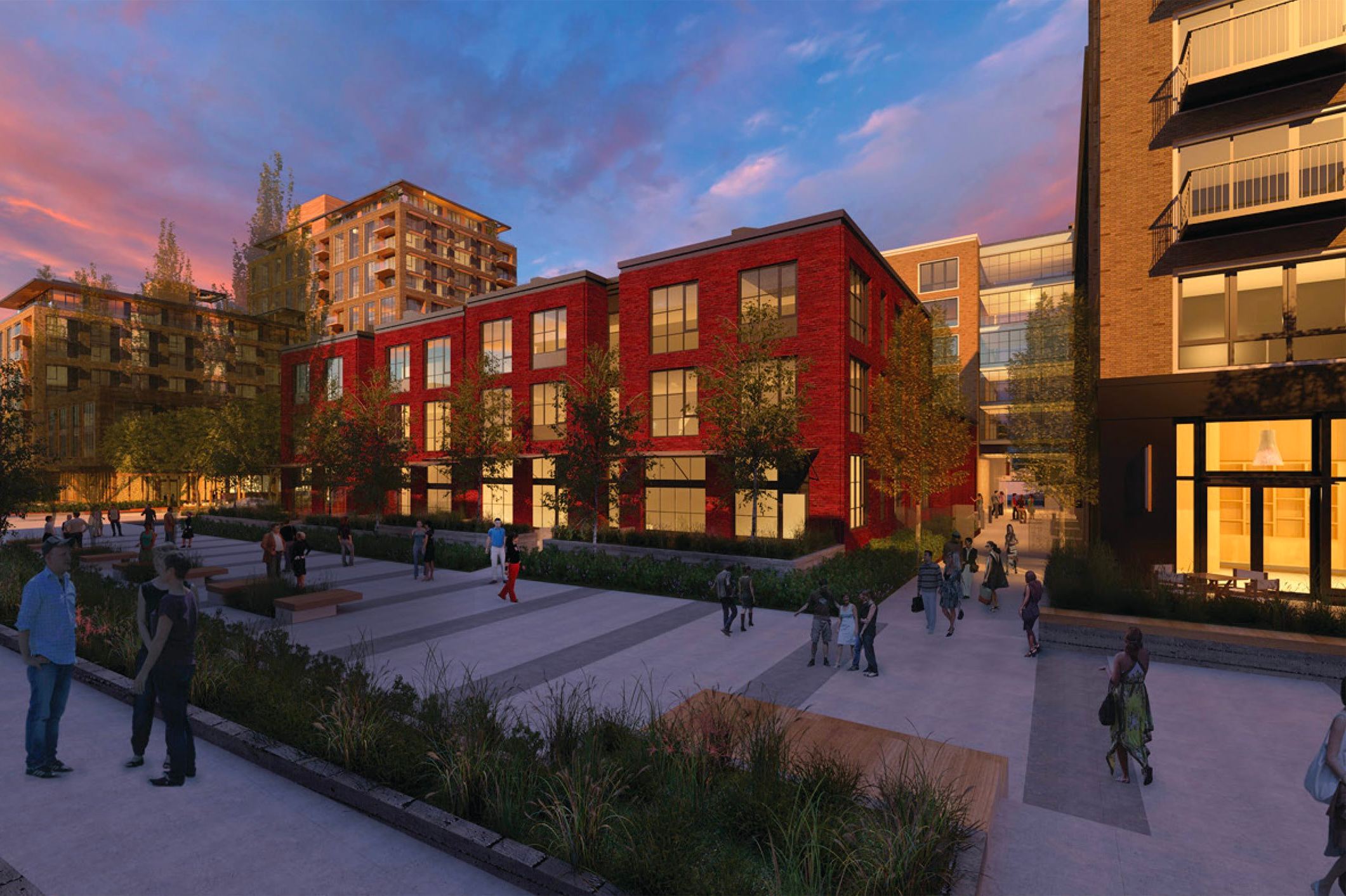
Meeting Summary: Mark Desbrow (previously from OPUS) and Noel Johnson (this committee) presented some very preliminarily ideas for the development of an adult coop building at 19th and Johnson. This is the third set of developers to look at this former motion picture storage and processing site. Despite the fact that this property lies outside the Alphabet district the committee continues to feel that the unique façade of the current buildings must be incorporated into any new structures. In the third and last meeting with the streetcar barn architects the committee moved to approve with modifications. The modifications asked for were, increased design emphasis on the building entrance and that the security fence be made out of some other material other than chain-link. - John Bradley, Committee Chairperson
Additional Meeting Notes:
Desbrow, Johnson (Johnson as developer, presenter.) Working on new venture, older adult cooperative housing.
Desbrow – worked on Park 19 apartments, left OPUS. Was commuting, but was also discouraged the way senior housing is managed, consolidated and run by large corporations. He was in financing and acquisitions, and had to run projections–a profit generating model that didn’t have the seniors interests in mind. This may work for an apartment–there are other options, but not for seniors with limited resources & unpredictable expenses.
There’s a model in the Midwest, cooperative housing, and they are cooperatively owned and hire their own site management.
This allows people to make a lifestyle choice early based on future concerns and needs. No limitation on income, can be mixed. HUD. Only option that allows equity retention by owners.
We have a few projects looking at, one with most legs is in NW: we have a group of people that have asked us to build a building for them, not speculative.
Johnson – options aren’t varied, we think this can be as exciting as buying a first house. Can choose amenities, assembled based on interest. 55+ is HUD requirement. This requires great sites: in other models people bring you property for senior housing because the don’t know what else to do with it.
SW corner of 19th and Lovejoy. Lovejoy used to have a vibrant history, mansions, now 19th has parking lots, Legacy, med office building.
Full building on the site, L shaped, would take the building down. Was Fox film site (1930’s) became MGM… Film chemicals were explosive so they build cast concrete walls, site has tiny rooms and small spaces. It’s two buildings as a single structural system.
The site has gone around to various interested buyers, OPUS, TCR. TCR had tried to save the lower building. We’re anticipating removing bad dirt since floor drains channeled chemicals into the soil. We don’t think we can save any of the buildings.
Desbrow – the environmental contaminants are the main reason we have to demolish the building. Not eligible for brownfields. Due to one-way on 19th and Streetcar on Lovejoy, entrance would be on Kearny, underground parking.
Czarneke – details and entrance scales are the best part, if you could save these and duplicate palazzo courtyard style and detail. Other buildings are around by the same architect. Would add an element to NW that is a counter to the Pearl.
Johnson – # of units will be determined by the number of members/purchasers. Desbrow–realistically expect a 5 or 6 story building. The code tops at 65’ if wood structure.
Stapleton – you’re talking about a co-op, Park Place on Vista. If a senior component are you talking age restricted? (Yes, it’s 55+) Is it contemplated to have services like a CCRC? Continuation of care?
Desbrow – in this model you don’t pay for services you don’t need, contract for in-home care provider would be available. Won’t have assisted living. Genasci–did you do testing for chemicals?
Johnson – we did take deep samples in alley, and cored through slab near internal drains.
Desbrow – $40,000 spent on environmental research.
Johnson – must haul off soils, can’t cap. Not much ground water, fortunately, expect only hot spots.
Vrilakas – at my age you develop a respect for the past. Even just a facade here would be salable.
Bradley – agrees, it’s a unique building. I’m sorry to hear the inside is contaminated. Silver, brominated hydrocarbons, breakdown of cellulose.
Johnson- cadmium.
Genasci – the front edge of 19th street is the best part of the building, cut the rest loose and there’s still room for a 5 or 6 story block. Would give a scale and entrance through these buildings that would be unique in modern buildings.
Talking about leaving the front of the building the depth of the primary building. Earthquake standards are met by tying this to the new structure. It’s a generous site, and an opportunity to put together the new with the old without a corny Disneyland thing.
We’ve done four early interest meetings, 75 people have come. We’re doing unit selection and collect deposits in September. Grass roots marketing has been successful, people want to live with friends. 50 units, units are customized. Most of the people have steep staircases in current residences. One of the hardest things for people leaving their house is their garden, so we’re looking at this. Possibly rooftop.
Johnson – so style is different than other buildings nearby, what cues should we take from other surrounding.
Czarneke – would not call it Disneyland to put a new Traditional style building. Would like to see a modern building adjacent, it’s so doable to have the traditional style.
Welch – historic facades and compatible infill were done in old town, setback options. I know these exist.
Website is done, and a good one.
Bradley – continuation of Streetcar Maintenance Facility review. Third meeting with this, some adjustments requirements and Design Review. Window patterning, entrance placement, fence with slats were concerns.
Knox – heard don’t comeback unless there’s some change. So we seriously went through this in light of committee’s comments. General theme: More interest and activity on 16th avenue, and fencing.
Form follows tracks, recaps how we got this design. Expansion first includes Eastside loop, more to come. Can’t say if this will become a permanent dead end.
Hendricks – re use: short term maintenance in this shop.
Knox – looked at regularization of windows which we discussed (shows drawing) and if entrance is added, to reach elevation change we lose office space–this was a quickly done study. Blows out constrained space on that side. Building entry sequence from a presence on the street perspective. (will continue momentarily)
Fencing differs from other areas in that it is inside the property & not on the sidewalk line. It’s required for security. Behind landscaping. This isn’t different from last week but I wanted to emphasize this.
Hendricks – on 16th we pulled back the fencing on the corner and landscaped as much as possible. Pulled fence back on the far side of the building, 5’ setback on Northrup.
Czarneke – Rose Gardens have chain link, painted green, black. This is a plain, metal & concrete building, could use color. Oregon green. This is a public utility, there was a day when these sorts of buildings were iconic public facilities. Charm factor could go up if you utilized paint. If the roof went up to the freeway, pitched, it could be much improved. Terra cotta color like train station, sign that calls it out.
Doesn’t mind the utilitarian aspect of the building on the street, but the randomness I didn’t like. Simpler, older buildings–train stations–could give a clue. The metal concrete look is alien.
Knox – From a customer perspective you do want the system to read as a whole, I take your point.
the bar part of the building starts taking on the proportions of a streetcar, someone here asked about murals. Talked with PSI about public art. I can plant the seed of having this part of the site put into that program.
Genasci – Drawing doesn’t solve the problem of the Bar area. If you flip the offices over, corridor on the backside, each office with a window to the street, make these larger?
Hendricks – they are 5’ x7’ tall. Ceiling height.
Genasci – those are reasonable. If you raised parapet could get more presence on the street. It’s easy to be functional and offers more to the street.
Hendricks – 15’ building at high side, 14’ at low side. Over half the spaces are toilets, janitors rooms, and wouldn’t have windows. Only one office. A pedestrian can look through this office, see streetcars inside, and also corridor activity.
Genasci – could also put the rooms you don’t want to see on one end. If you really want to solve the problem, it’s not that difficult to solve. The issue is getting a presence on the street and not turn the building’s back to the street.
Hendricks – we took the comments about the presence on the street and the entrance relationship to 16th. Similar, but have reshaped trellis, extended as part of the plaza, 15’ tall. Added extra, lower element at sidewalk, added planters, green on the street, and planters along the ADA ramp. Private entrance but reads more as a public entrance.
Mikolavich — One response to this concern is an entrance on the center of the street side, the other is a courtyard entrance, which is what we’ve done.
Hendricks – trellis also wraps around to point you towards the entrance.
Theisen – Trellis makes me think of open screen.
Hendricks – it’s light framed steel with mesh, solid element over entrance door.
Genasci – secondary trellis marks what looks like entrance but it’s not. People will be going there. Can cantilever trellis over the street, so it marks the entrance.
Hendricks – lower trellis is for the pedestrian on the sidewalk.
Genasci – if you ran it down the whole building?
Vrilakas – I understand the programmatic problems with the door placement, the trellis for pedestrians is nice, run the whole length.
Theisen – it’s open, so no shelter from the rain.
Czarneke – If you put a slanted roof by the entrances it makes a building in itself. I see a thin wall, I want to see a solid wall punched. Window and door closer, utilitarian. Either move the entry or do a simple, iconic thing. Too much fuss trying to do something.
Pitched roof would go with other roof better. Very plain. Friendlier street element. More uniformity without bottom set of windows.
Bradley – calls end of discussion. Review is due Monday, August 10th.
Still have slatted cyclone fence, pulled back and landscaped.
Bradley suggests fencing as art project. Email messages will seek quorum if need for meeting before end of August.
Design Advice Request for Overton Pettygrove 14th-15th formerly Fosler’s work on office. Looks residential. Outside NA, but on the edge.


Attention: Don Genasci
I thought you might find this interesting. I still think underground parking would be great for the northwest district.
http://www.woehr.de/en/projekte/budapest_m730/index.htm